A small oak tree grows beside the deck of the villa where I'm writing and hangs over the marsh. It spits tiny acorns on the deck and attracts bluejays, who have a fondness for acorns. So it is that the bluejays and I have become friends this month, however one-way the affection.
Despite being much maligned for their unpleasant cawing and their reputation for nest-robbing, bluejays offer a striking kind of beauty to the world, with their distinctive combination of blue, black, and white feathers, and I've long wondered at their ability to mimic a hawk's whistle. I've often heard them give a pretty kind of hoot at home, not raspy or ugly at all.
Now, watching the Fripp bluejays at close range across these winter weeks has given me a new appreciation for their behavior, as well. They come in a group of three or four, perhaps a family, to perch on the banister in search of acorns. They hold the acorns in their feet to strip the cap and crack open the meat with their beaks. They take turns hopping to the chair on the deck that holds rainwater in its seat. They take long draws of water through their bills, like straws, then lift their heads to swallow. Their neck feathers bounce as their throats open and close, allowing the water to trickle into their bodies.
No raspy calls here, only contented sorts of coos as they enjoy their meals together. Their crests are as often down as up, and they are civil to each other, taking fair turns at the puddle in the chair. This morning one flew to the banister out of the marsh with a tiny crab flailing in its beak, then off to enjoy it somewhere else.
On the Cornell Laboratory site, http://www.allaboutbirds.org/guide/Blue_jay/lifehistory/ac, I was thrilled to learn their reputation for stealing eggs is grossly exaggerated. And their raspy caws are not just bad manners, but warnings to their own and other species of pending danger. Not only that, they are credited with the regular distribution of oak trees across the eastern half of the U.S.
I'm sorry I misjudged them, in a past blogpost called Arrogance and Beauty. What I called "bad manners" were more likely deeds of social justice. I was, of course, the danger they warned against. So they were wrong too. I would never harm them. But once again, the more I learn the more I discover how errant my guesses can be. It's lovely to discover I can spend the last third of my life respecting the handsome bluejays in my backyard. dkm
Tuesday, January 24, 2012


Wednesday, January 11, 2012
Pelicans on a Rainy Day
The beauty of the brown pelican is the color of its underwing. Black. Unremarkably tan of back and upperwing, noticeably white of head, when brown pelicans flap between soars, their underwings flash eerie hints of mystery. When they disappear on a long slow glide into the marsh grass, they send me right back to the page to ferret out more.
Another thing about them is the absolute stillness of their heads and bodies in flight, even as their wings alternate between easy pumping and long soaring. Their heads are hunched back as if fused to their shoulders, holding their eyes steady, the better to see a fish with. There's a lesson for a writer in their calm. In their patient focus.
And another thing. Their activity over the marsh does not stop in the rain. Few other birds are visible out there in this weather, but the pelicans carry on. I guess if one dives into water for a living, what matter a few raindrops? The brown pelicans of Fripp Island, S.C. are practically revising today's chapter for me. dkm
Another thing about them is the absolute stillness of their heads and bodies in flight, even as their wings alternate between easy pumping and long soaring. Their heads are hunched back as if fused to their shoulders, holding their eyes steady, the better to see a fish with. There's a lesson for a writer in their calm. In their patient focus.
And another thing. Their activity over the marsh does not stop in the rain. Few other birds are visible out there in this weather, but the pelicans carry on. I guess if one dives into water for a living, what matter a few raindrops? The brown pelicans of Fripp Island, S.C. are practically revising today's chapter for me. dkm
Monday, January 9, 2012
Mozart and the Marsh
Except for shorebirds that disappear into it and trees that grow on the far side of it, Fripp Island marsh in January has the look of a Kansas wheat field in July, like a musical variation on a theme. But I think the marsh harbors more secrets than a wheat field, due to its never getting run over by a combine.
Whenever I return to the arrogant landscape of my birth, the big sky and flat terrain bellow without shame, "You know, don't you, that Kansas represents the standard topography from which all other landforms are mere variations?" Mere. Simple, ordinary, minor.
Mozart composed fourteen piano variations on the simple French tune known to English-singing children as Twinkle Twinkle Little Star. Like landforms, not one of them is mere. Musically speaking, each is magnificent as a geological terrain. A prairie, a marsh, a foothill, a mountain, a canyon, a cliff, a forest, a dessert, a swamp, a mesa, a beach, a reef, a rock, or a dune, to name fourteen of them. To listen to Mozart's variations is to experience fourteen musical moments of pleasure. Almost enough for a lifetime. If any of my family ever reads this, Mozart's Variations on Twinkle would be suitable funeral music for me. And don't forget Chopin's Opus 39, Number 2, played only by Arthur Rubenstein, no one else. Just saying.
Three pelicans flying low over the marsh started this reminiscence, wings pumping in unison, bodies remaining level. They vanished into the grass without a trace, later to emerge like a new idea. The secrets of the marsh are beginning to reveal themselves. Chapter one of forty-four down. dkm
 |
| Fripp Island marsh cropped to wheat field |
 |
| Fuller view from Peggy Yaya's deck |
Whenever I return to the arrogant landscape of my birth, the big sky and flat terrain bellow without shame, "You know, don't you, that Kansas represents the standard topography from which all other landforms are mere variations?" Mere. Simple, ordinary, minor.
Mozart composed fourteen piano variations on the simple French tune known to English-singing children as Twinkle Twinkle Little Star. Like landforms, not one of them is mere. Musically speaking, each is magnificent as a geological terrain. A prairie, a marsh, a foothill, a mountain, a canyon, a cliff, a forest, a dessert, a swamp, a mesa, a beach, a reef, a rock, or a dune, to name fourteen of them. To listen to Mozart's variations is to experience fourteen musical moments of pleasure. Almost enough for a lifetime. If any of my family ever reads this, Mozart's Variations on Twinkle would be suitable funeral music for me. And don't forget Chopin's Opus 39, Number 2, played only by Arthur Rubenstein, no one else. Just saying.
Three pelicans flying low over the marsh started this reminiscence, wings pumping in unison, bodies remaining level. They vanished into the grass without a trace, later to emerge like a new idea. The secrets of the marsh are beginning to reveal themselves. Chapter one of forty-four down. dkm
 |
| Doesn't actually go with this post, but cool shadows on the marsh, not? JR will like this:-) |
Friday, January 6, 2012
For the Time Being
Day four of thirty into this writing retreat, and I have yet to dig into the chapters I came to revise. Procrastinating, yes, but I'm seeing procrastination differently than I once did. Having now been on a number of similar retreats, I've learned that it takes a few days to shed the stuff of real life in Decatur---to come to the sense of quietude required to burrow into a fictitious life of story. I know from past experience, I will eventually find the story, and while I still wrestle with these days, I'm beginning to reduce the angst they cause by viewing the battle as a necessary part of the process. Maybe these few days are actually pretty effective writing tools---important as pencils and erasers---days I must wander through to get to the place, time, and mode of writing---a place, time, and mode that cannot be achieved without a few days' time.
The beauty of this insight, I hope, is that time will make the days go by whether or not I'm fighting them. If I spend them reading, sitting, staring at the marsh, thinking, meditating, walking, breathing, and being, perhaps I will arrive at the page on the other side of them less used up, more fortified for the story.
Sounds good in theory, does it not? I'll report back in "a few days." In the meantime, many thanks to Sheila & Barbara for the sleeping house, and to Peggy & Bill for the writing house. I'll write more about my gracious hosts tomorrow. Today, there is the marsh to observe, the path to walk, and the breath of the universe to take in and out of my lungs. dkm
The beauty of this insight, I hope, is that time will make the days go by whether or not I'm fighting them. If I spend them reading, sitting, staring at the marsh, thinking, meditating, walking, breathing, and being, perhaps I will arrive at the page on the other side of them less used up, more fortified for the story.
Sounds good in theory, does it not? I'll report back in "a few days." In the meantime, many thanks to Sheila & Barbara for the sleeping house, and to Peggy & Bill for the writing house. I'll write more about my gracious hosts tomorrow. Today, there is the marsh to observe, the path to walk, and the breath of the universe to take in and out of my lungs. dkm
Wednesday, January 4, 2012
Rue Not This Day
If not birders, they are at least respecters of the natural world, the older couple that stopped in their tracks today when they saw two great egrets light a good distance ahead of them on the boardwalk. They were crossing the marsh on Fripp Island, where I am visiting for another writing retreat. From my writing house, I happened to be watching the egrets through the binoculars when the couple came into view. They are people I'm sure I would like.
Everything about their standing still there was a measure of love. Their stooped posture, their slow progress halted, and the way they supported each other in the act of not disturbing the egrets, did for me what Robert Frost's dust of snow must have done for him when he wrote:
"The way a crow shook down on me,
The dust of snow from a hemlock tree,
Has given my heart a change of mood,
And saved some part of a day I had rued."
The couple did not continue on the path until a third egret flew over, and the two on the banister joined it in flight. I had rued this day for not getting any of the work I came to do done. The couple and the egrets changed everything. dkm
Everything about their standing still there was a measure of love. Their stooped posture, their slow progress halted, and the way they supported each other in the act of not disturbing the egrets, did for me what Robert Frost's dust of snow must have done for him when he wrote:
"The way a crow shook down on me,
The dust of snow from a hemlock tree,
Has given my heart a change of mood,
And saved some part of a day I had rued."
The couple did not continue on the path until a third egret flew over, and the two on the banister joined it in flight. I had rued this day for not getting any of the work I came to do done. The couple and the egrets changed everything. dkm
Wednesday, November 16, 2011
Ya-Yas Walking
Home again. Leaves again. An oak branch hangs low over the road where I walk with my ya-yas on alternate week-day mornings. We have to duck or swerve to miss it.
We've been exercise-walking together for many years, this group of three ya-yas, so named by one of our daughters after The Divine Secrets of the Ya-Ya Sisterhood. We have six daughters among us. I'm so afraid it's in one of our daughters' destinies to write a book about us. Whoever it turns out to be, may she please wait till we're all dead.
But I digress. More than its hanging in our way, the thing that has attracted me to this branch for at least three years, is that one of its twigs grows large lobeless leaves on a tree otherwise full of deeply lobed bristle-tipped leaves. How can that be?
At first we thought it was a caught branch fallen from another tree. Determining that not to be the case, we accepted it as some anomaly of the season, likely a one-time occurrence. But no, three years later the branch still produces the same oddly rounded leaves it has grown for at least as long as we've been attending it and probably longer. Our tree, by the way, is huge and many generations older than we.
I don't know my oaks, but the broad toothless leaves on the odd branch look to match the leaves of a blackjack oak in the field guides. The branch itself appears to have been damaged---as in possibly broken by a passing truck, then healed. Could that be the reason for the leaves of wonder? I'd be grateful to any tree experts out there who can explain. dkm, aka ya-ya #3
We've been exercise-walking together for many years, this group of three ya-yas, so named by one of our daughters after The Divine Secrets of the Ya-Ya Sisterhood. We have six daughters among us. I'm so afraid it's in one of our daughters' destinies to write a book about us. Whoever it turns out to be, may she please wait till we're all dead.
But I digress. More than its hanging in our way, the thing that has attracted me to this branch for at least three years, is that one of its twigs grows large lobeless leaves on a tree otherwise full of deeply lobed bristle-tipped leaves. How can that be?
At first we thought it was a caught branch fallen from another tree. Determining that not to be the case, we accepted it as some anomaly of the season, likely a one-time occurrence. But no, three years later the branch still produces the same oddly rounded leaves it has grown for at least as long as we've been attending it and probably longer. Our tree, by the way, is huge and many generations older than we.
I don't know my oaks, but the broad toothless leaves on the odd branch look to match the leaves of a blackjack oak in the field guides. The branch itself appears to have been damaged---as in possibly broken by a passing truck, then healed. Could that be the reason for the leaves of wonder? I'd be grateful to any tree experts out there who can explain. dkm, aka ya-ya #3
 |
| Odd branch in September 2011 |
 |
| Odd branch with Ya-ya Peggy |
 |
| September 2011 |
 |
| October 2011, different angle |
 |
| Two leaves from same tree, November 2011 |
 |
| Ya-yas Peggy and Pearl |
Thursday, November 3, 2011
Compost: Rotten and Rich
Owing to a lifetime of teaching first grade, I admit to a certain guilty pleasure this year in having no children around for whom I felt obligated to toast pumpkin seeds, or now to turn the jack-o-lantern into a pie. He looks suitably handsome in the organic rubbish heap, soon to be rotten and rich compost. Is it not an equally worthy end?
Who knew retirement would be so freeing as this? dkm


Who knew retirement would be so freeing as this? dkm


Tuesday, October 25, 2011
October Blue

The four most recent trips have all been to joyful and celebratory events, important and precious in countless ways, but they have allowed no time for simply being outside. I've been to AL for a nephew's wedding, to PA for a family reunion, to KS for a five-friends reunion, and to IN for my daughter's wedding. All of these events enriched my life beyond measure, and I would not have missed them for the world. But lacking downtime, I have wound up tight as a spring.
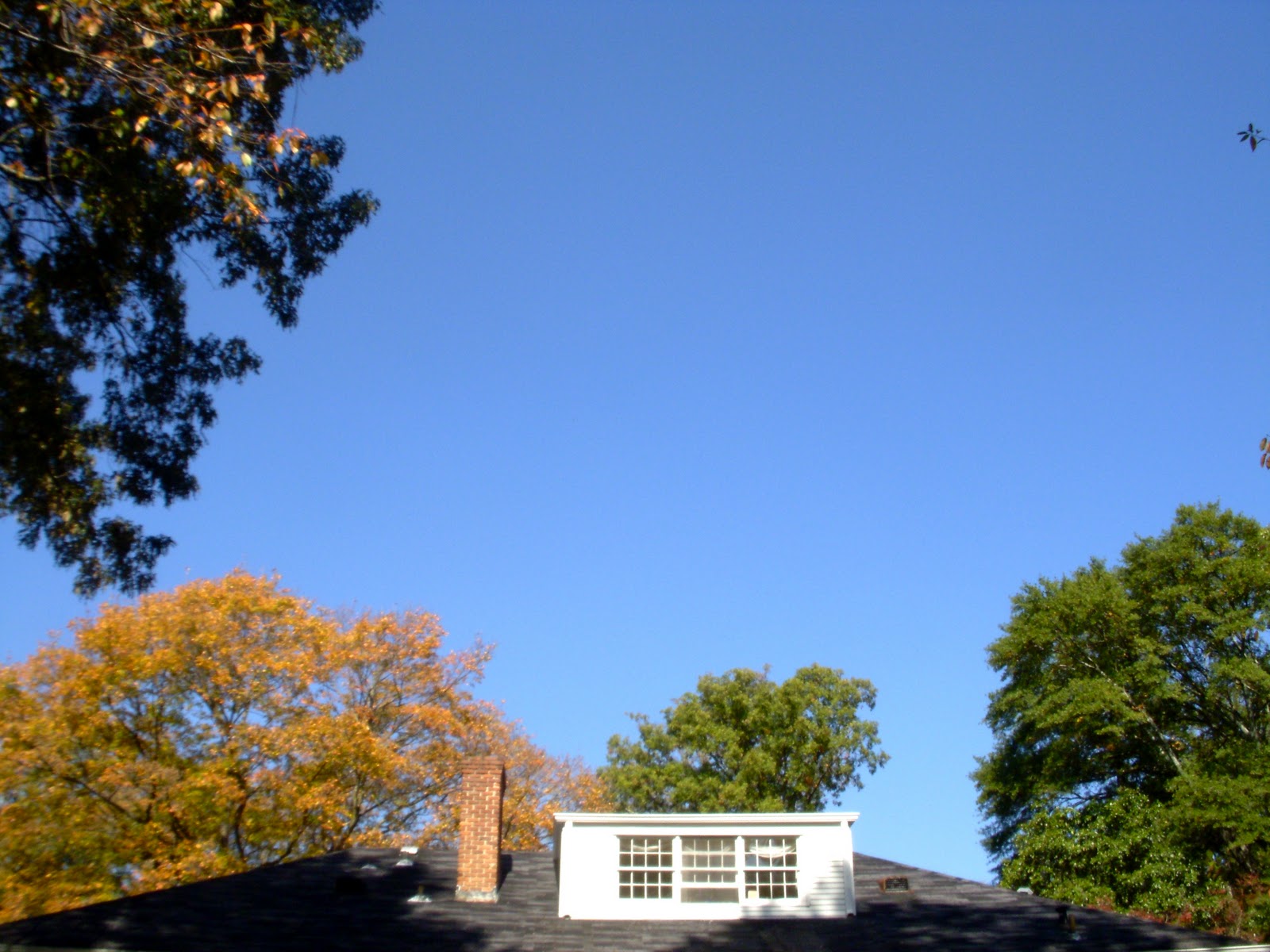
I had imagined blogging retroactively about the goat farm in AL, the mountains in PA, the skies in KS, the maples in IN, but today's crystalline October air in GA says to let them all go in exchange for the present---to breathe and nothing more---it is enough. And so it is. dkm
Thursday, September 29, 2011
Do You See What I See?
A pair of them came calling at the sliding glass door one evening after dark, as curious about me and my light as I was about them and their noise. Or maybe they've learned that light at night in a house that is commonly dark might mean good trash. Whether they were more curious or expectant, I was all curiosity from my side of the door. First came a great deal of leaf rustling outside on the deck, then a scritch scratch on the glass, then two sets of front paws pressed against the glass, followed by two adorable raccoon faces peering back at me. I leaned over the arm of my big comfy reading chair to get a better look at them. The light from my reading lamp shone directly on them for a clear view. We were less than two feet apart, but they didn't run. Quite the opposite.
They pulled up straight with deadpan faces, turned to glance at each other, then back at me---not unlike those funny tv commercials where someone says something inane and the other person responds with a blink that says the statement has registered, but the receiver doesn't immediately know what to make of it. That's how the raccoons responded to my face in the glass. I laughed out loud. They calmly backed down and walked away.
It's a lovely comical memory from my recent writing retreat on Wilmington Island, and I send my gratitude to good friends Paul and Carla for the use of their vacation home overlooking the Wilmington marsh. It is for me a place for rest, reflection, and slow passage of time. A sacred place free of tv, radio, news, music, calendar, and interruptions. A place to feel fully steeped in the simple complexity of the natural world---none of it remotely interested in me or my writing---with the possible exception of the raccoons---all of it alive with the energy of the universe. A place that offers the luxury of burrowing deep into story and staying there, day and night, and sooner or later, despite powerful avoidance strategies, to write. Six more chapters drafted.
Thanks, Paul and Carla. Your names will be in the acknowledgment page if this manuscript ever gets whittled enough to find a publisher! dkm
They pulled up straight with deadpan faces, turned to glance at each other, then back at me---not unlike those funny tv commercials where someone says something inane and the other person responds with a blink that says the statement has registered, but the receiver doesn't immediately know what to make of it. That's how the raccoons responded to my face in the glass. I laughed out loud. They calmly backed down and walked away.
It's a lovely comical memory from my recent writing retreat on Wilmington Island, and I send my gratitude to good friends Paul and Carla for the use of their vacation home overlooking the Wilmington marsh. It is for me a place for rest, reflection, and slow passage of time. A sacred place free of tv, radio, news, music, calendar, and interruptions. A place to feel fully steeped in the simple complexity of the natural world---none of it remotely interested in me or my writing---with the possible exception of the raccoons---all of it alive with the energy of the universe. A place that offers the luxury of burrowing deep into story and staying there, day and night, and sooner or later, despite powerful avoidance strategies, to write. Six more chapters drafted.
Thanks, Paul and Carla. Your names will be in the acknowledgment page if this manuscript ever gets whittled enough to find a publisher! dkm
Thursday, September 8, 2011
Sunsets Eternal
"This grand show is eternal. It is always sunrise somewhere; the dew is never all dried at once; a shower is forever falling; vapor is ever rising. Eternal sunrise, eternal sunset, eternal dawn and gloaming, on sea and continents and islands, each in its turn, as the round earth rolls."
John Muir, naturalist, explorer, and writer (1838-1914)
Forever followed, never reached, what is there more alluring than the spectacle of a setting sun perpetually leading the way over the western horizon? Having grown up in the land of the big sky, Kansas, where stunning sunsets are not rare, I discover in my adult life in Georgia, where they are, that I am easily beguiled by the prospect of an inspiring sunset. While I've come to depend on the soothing effect of the trees of Atlanta, I will ever be drawn to that mysterious evening mix of cloud and light, never the same in hue or contour. So it is that when I go to a beautiful place on a writing retreat, I make an effort to get to a place of quietude by sunset time. The most beautiful ones defy the camera. Last October, one memorable sun sat right down on the end of a long ribbon of highway I was traveling and filled up my windshield. My throat still catches at the memory of it. Below are a few recent captures in San Francisco, Gulf Breeze, FL, Lake Junaluska, SC, Wilmington Island, GA. Nothing like a good sunset to stoke an aspiring writer for another chapter. dkm


Subscribe to:
Posts (Atom)


